
Science
Intent
Question • Investigate • Conclude
At St Joseph’s Catholic Primary School, we follow the Kapow Primary Science scheme to deliver a rich, engaging and progressive science curriculum that inspires curiosity about the world around us. We want children to see themselves as scientists: asking questions, exploring ideas, solving problems and developing a deeper understanding of how and why things happen.
Our curriculum aims to develop children's scientific knowledge and understanding alongside the skills they need to think and work scientifically. Through the study of Biology, Chemistry and Physics, pupils build a secure understanding of the natural and physical world whilst developing the ability to investigate, analyse and communicate scientific ideas.
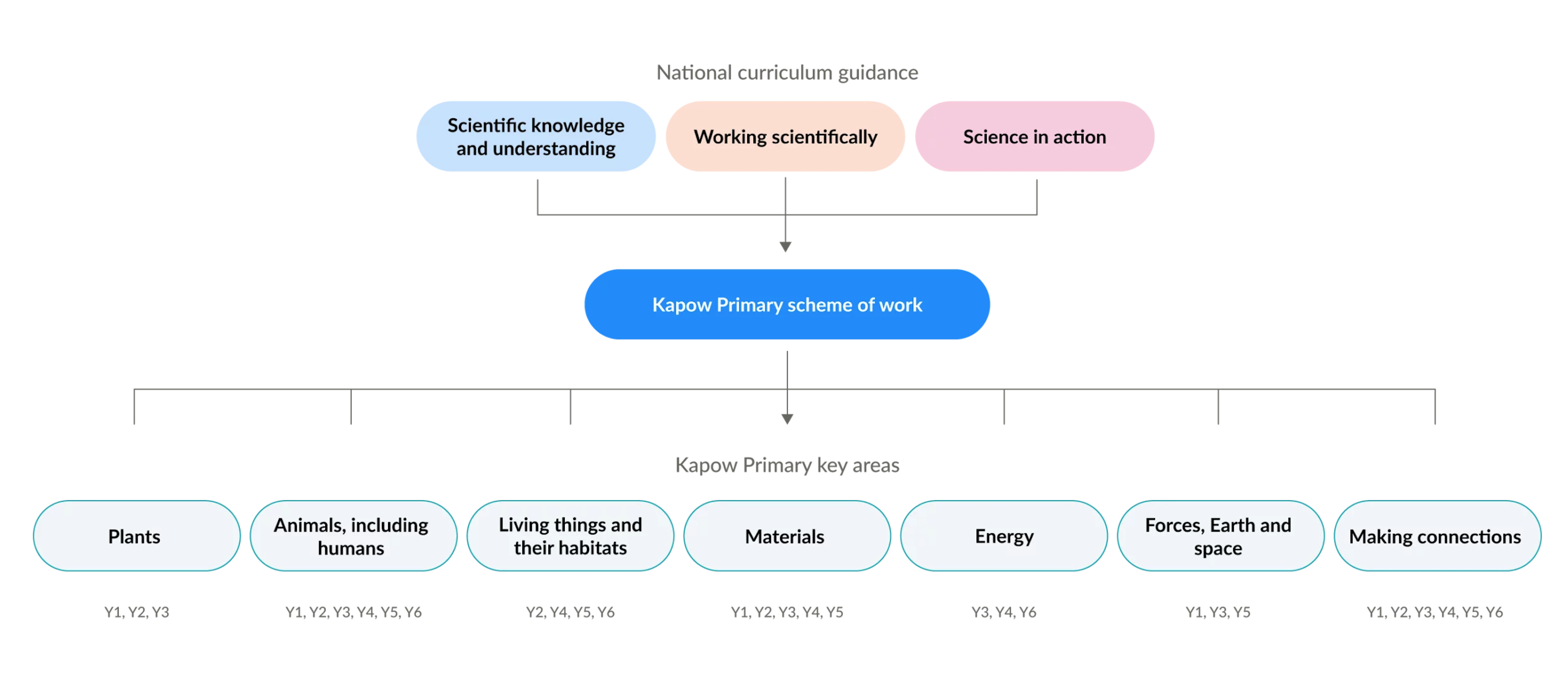
The curriculum is built around three key strands:
- Scientific Knowledge and Understanding – developing knowledge across Biology, Chemistry and Physics.
- Working Scientifically – developing enquiry skills such as questioning, observing, testing, measuring, analysing and evaluating.
- Science in Action – understanding the role science plays in everyday life and recognising the contributions of scientists, innovators and discoveries that have shaped our world.
We want children to experience science as a practical, meaningful and exciting subject. They are encouraged to be curious, challenge ideas, communicate their thinking and use increasingly precise scientific vocabulary to explain their understanding.
As children move through school, they build on prior learning and become increasingly independent in their scientific thinking. We aim for all pupils to leave St Joseph’s with the knowledge, confidence and curiosity to continue exploring science at secondary school and beyond.
Implementation
Science is taught regularly across the school through the Kapow Primary Science curriculum. In EYFS, scientific understanding begins within the Understanding the World area of learning and provides the foundations upon which future scientific knowledge and enquiry skills are built.
Kapow follows a spiral curriculum model, enabling key knowledge, concepts and skills to be revisited and developed with increasing complexity as children progress through the school. This approach supports long-term retention, helps children make connections between different areas of learning and deepens understanding over time.
Throughout their learning journey, children study a broad range of scientific topics including:
- Plants
- Animals, including humans
- Living things and their habitats
- Materials
- Forces
- Energy
- Electricity
- States of Matter
- Sound
- Light
- Earth and Space
- Evolution and Inheritance
Working scientifically is woven throughout every unit. Children develop their ability to:
- ask scientific questions;
- make predictions;
- plan and carry out investigations;
- observe over time;
- identify, classify and group;
- measure accurately using scientific equipment;
- gather, record and present data;
- identify patterns and relationships;
- draw conclusions from evidence;
- evaluate findings and suggest improvements.
Practical investigations form an essential part of science learning at St Joseph’s. Children are provided with regular opportunities to explore ideas, test hypotheses, gather evidence and discuss their findings. As they move through the school, they take increasing responsibility for designing investigations, selecting equipment and making decisions about how enquiries should be carried out.
Scientific vocabulary is explicitly taught, modelled and revisited throughout each unit. Teachers carefully build upon prior learning, address misconceptions and support pupils in making meaningful connections across scientific concepts.
Science learning is enriched through outdoor learning opportunities, educational visits, STEM activities, workshops and enquiry-based projects. Pupils are encouraged to see science as a subject that extends beyond the classroom and plays a vital role in understanding and improving the world around them.
Impact
By the time children leave St Joseph’s Catholic Primary School, we want them to have developed a genuine enjoyment of science and an understanding of its importance in everyday life and the wider world.
Children will have developed secure scientific knowledge and will be able to apply this understanding when asking questions, making predictions, planning investigations and explaining scientific concepts.
Pupils will increasingly be able to:
- recall and apply key scientific knowledge;
- use scientific vocabulary accurately and confidently;
- ask relevant and purposeful scientific questions;
- plan and carry out appropriate enquiries and investigations;
- use equipment safely and accurately;
- gather, record and analyse data effectively;
- identify patterns and relationships;
- draw conclusions supported by evidence;
- evaluate scientific investigations;
- understand the role of science in society and the wider world.
As pupils progress through the curriculum, they become increasingly confident and independent scientists. They learn to think critically, solve problems, communicate findings effectively and use evidence to justify their ideas.
Teachers assess learning through questioning, discussion, written outcomes, practical investigations and end-of-unit assessments. Monitoring through pupil voice, book looks and lesson visits ensures that pupils build knowledge and scientific enquiry skills progressively throughout their time at St Joseph’s.
Oracy Opportunities
Through our science curriculum, pupils have regular opportunities to:
- ask and discuss scientific questions;
- explain observations and findings using scientific vocabulary;
- justify predictions and conclusions using evidence;
- participate in collaborative investigations;
- discuss and evaluate methods and results;
- present scientific findings to different audiences;
- debate scientific issues and ethical questions;
- communicate ideas through presentations and demonstrations;
- listen carefully to the ideas and viewpoints of others;
- develop confidence when speaking in front of groups.
These opportunities help children become articulate, confident communicators who can explain their thinking clearly, reason scientifically and engage thoughtfully in scientific discussion.
Catholic Ethos
Our science curriculum reflects our Catholic mission by encouraging pupils to develop a sense of awe and wonder about God's creation. Through exploring the natural world, children develop an appreciation of the beauty, complexity and interconnectedness of life.
The curriculum encourages pupils to:
- recognise the wonder of creation;
- develop respect for living things and the environment;
- understand their responsibility as stewards of the Earth;
- appreciate the contribution of scientists to improving lives;
- consider the ethical implications of scientific developments;
- show curiosity, honesty and integrity in scientific enquiry;
- use their knowledge and skills to contribute positively to society.
Through science, pupils are encouraged to understand how scientific knowledge can be used to serve others and care for our common home.
British Values
- Democracy: Sharing ideas, asking questions and considering different viewpoints.
- Rule of Law: Following scientific rules, safety procedures and fair-testing principles.
- Individual Liberty: Exploring scientific ideas independently and making evidence-based decisions.
- Mutual Respect: Working collaboratively and valuing the views and contributions of others.
- Tolerance of Those with Different Faiths and Beliefs: Appreciating the contributions of scientists from diverse cultures, backgrounds and traditions.